


Removing the Windows 260 Character Limit with ndSync
If you use ndSync to sync NetDocuments content to your local machine, you may have encountered an error message about file paths being too long.
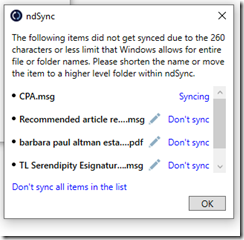
This happens because of a longstanding Windows limitation—and fortunately, there’s an easy fix.
The Problem
ndSync lets you sync portions of your NetDocuments repository to your computer, which is invaluable when you’re working somewhere with unreliable internet. However, Windows has historically enforced a 260-character limit on file paths. If the combined length of your folder path and file name exceeds 260 characters, Windows simply won’t support it.
NetDocuments itself has no such restriction, so it’s entirely possible to create deeply nested folder structures or lengthy file names that work perfectly in the cloud. The issue only surfaces when you try to sync that content locally.
The Solution
Microsoft quietly removed this limitation in Windows 10, but the setting isn’t enabled by default. To turn it on, you’ll need to make a quick registry edit.
Navigate to:
Computer\HKEY_LOCAL_MACHINE\SYSTEM\CurrentControlSet\Control\FileSystem
Find the LongPathsEnabled key and change its value from 0 to 1.
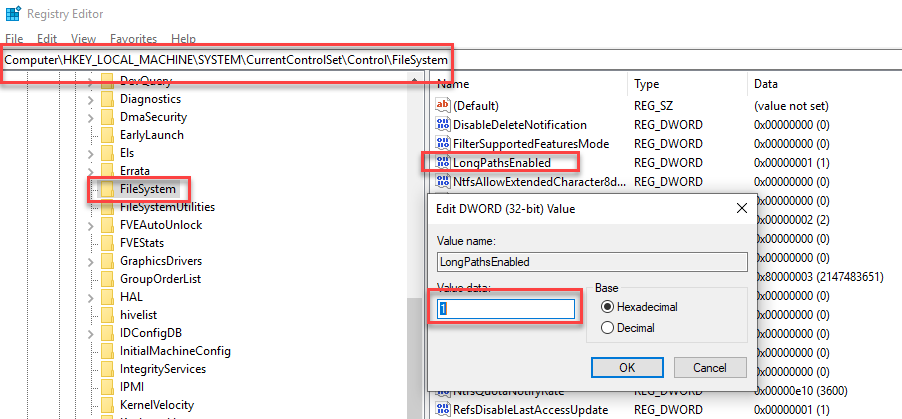
Alternatively, you can enable this setting through Group Policy if your firm manages workstations centrally.
ndSync Support for Long Paths
ndSync fully supports long path names—but only if Windows is configured to allow them. Once you’ve made the registry change and confirmed you’re running the current version of ndSync, restart your computer. Those frustrating path length errors should disappear.