

NetDocuments will release updates to ndMail and ndOffice throughout the year. When we set up NetDocuments, we block individuals from updating their computers. This prevents them from bricking their workstations. We recommend waiting a month before attempting to update when an update is released.
Based on our NetDocuments update schedule, we typically advise law firms to plan for upgrades in February/March and July/August.
If you want to know when stuff is updated, please follow this page: https://support.netdocuments.com/s/topic/0TO4Q000000cNNNWA2/announcements?tabset-42c89=2.
Download Links for the latest version of ndMail and ndOffice
https://apps.netdocuments.com/apps/ndOffice/ndOfficeSetup.msi
https://apps.netdocuments.com/apps/ndOffice/ndOfficeSetup.exe
https://apps.netdocuments.com/apps/ndMail/ndMailSetup.exe
https://apps.netdocuments.com/apps/ndMail/ndMailSetup.msi
Manual Install (Running this individually on each PC)
After you update, you will be forced to log back into NetDocuments.
Step 1: Create a Folder called C:\NetDocs
Step 2: Download the ndOffice and ndMail exe files and save them to C:\NetDocs
Step 3: Download the correct batch file to your computer
Step 3: Restart your PC
Step 4: Run the ndOffice EXE
Step 5: Run the ndMail EXE
Step 6: Right-click on NetDocuments Workstation Batch File.bat and choose ‘Run as administrator’.
Step 5: Open up Microsoft Word, Excel, or Outlook
This will force the ndoffice to open
Step 5: Click Please log in

Step 6: Check the open browser automatically and click login
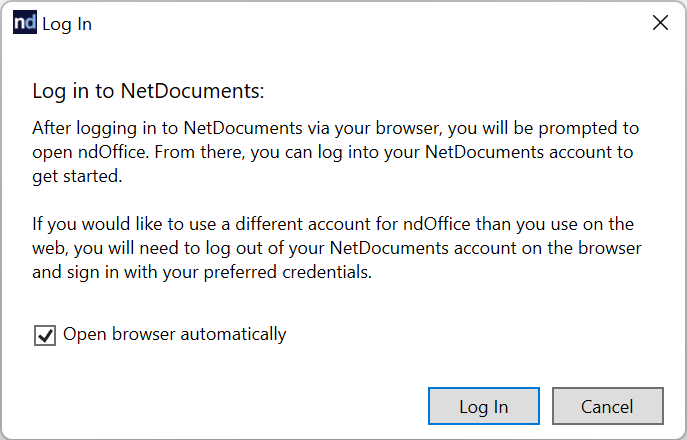
Step 7: Log in to NetDocuments
You should already be logged in to NetDocuments; if not, please log in. If you are having issues logging in, see: https://optiable.com/using-netdocuments-for-the-first-time-windows-login/
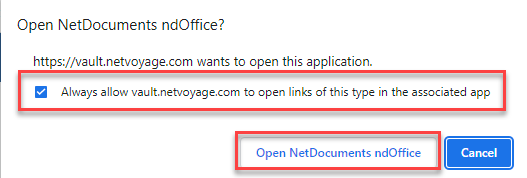
Step 8: Click Allow

Step 9: Click Always Allow, and click Open NetDocuments and ndOffice
Scripted Install (MSI)
Step 1: Uninstall ndOffice
Step 2: Uninstall ndMail
Step 3: Push out the new version of ndmail and or ndOffice
Step 4: Push out the correct batch file
Where IT Firms mess this up
After over 550 installations, we have found that some IT Providers gloss over the fact that this contains both HKLM and HKCU registry entries. HKLM keys are easily pushed out. HKCU Keys are not. If you log on as an administrator to a machine and try to push out HKCU keys, it won’t work. Please note that you must be logged in as the current user. To circumvent this, you can place the HKCU batch file in a login script when the current user logs in; the HKCU keys will then be applied appropriately.
I would download the exes and push them out in a silent install:
Silent Install
If you wanted to use a bat file, you would paste the contents below into a batch file:
“\\server\source\NetDocuments\ndOffice\ndOfficeSetup.exe” /quiet /norestart
“\\server\source\NetDocuments\ndMail\ndMailSetup.exe” /quiet /norestart