

Microsoft Office sometimes disables add-ins automatically to improve performance. This isn’t unique to NetDocuments—it affects any program that integrates with Office. The good news: it’s easy to fix.
Outlook
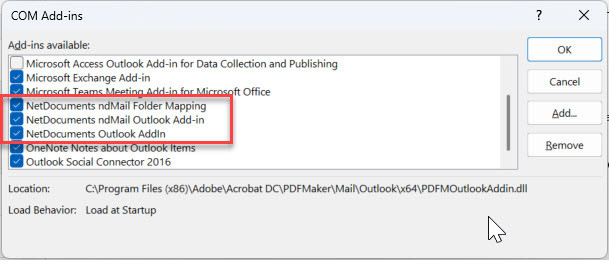
Outlook uses three separate NetDocuments add-ins, and each one can be disabled independently:
- NetDocuments Outlook Addin – The core NetDocuments integration for saving and opening documents. This is installed when ndOffice is installed on a workstation.
- NetDocuments ndMail Outlook Add-in – The email predictive filing dialog that appears when sending or saving emails.
- NetDocuments ndMail Folder Mapping – Syncs Outlook folders with NetDocuments for automatic email filing. (This isn’t always installed)
Here is what Outlook should look like if they are all installed correctly:
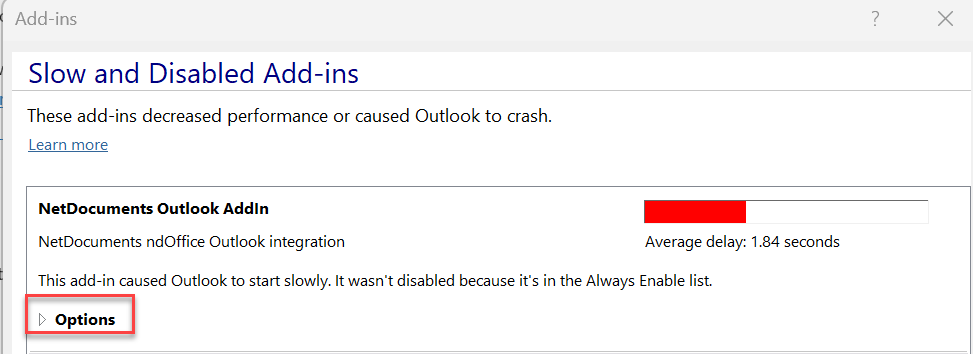
Option 1: Slow and Disabled Add-ins
Step 1: Go to File –> Slow and Disabled Com Add-ins
Step 2: If anything in NetDocuments is yellow, click options and Enable.
Option 2: Disabled Items
Step 1: Go to File → Options → Add-ins
Step 2: At the bottom of the window, change the “Manage” dropdown to Disabled Items and click Go
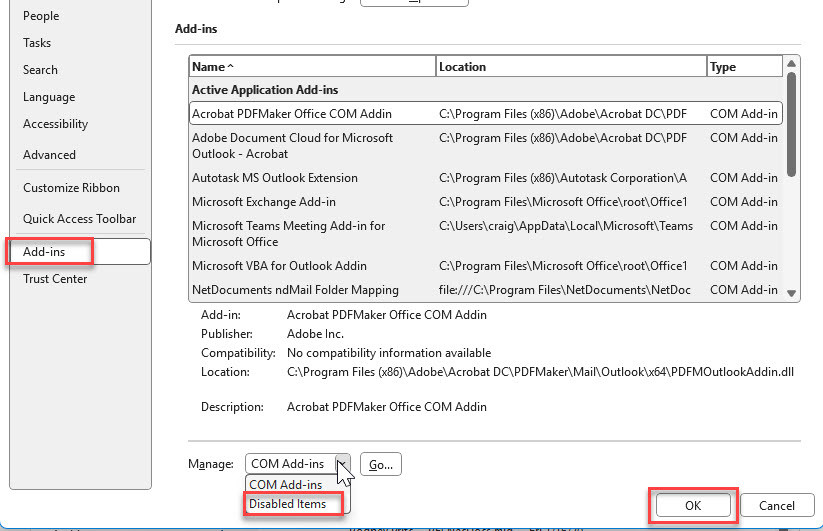
Step 3: If you see NetDocuments anything with NetDocuments Disabled, select it and click Enable
- NetDocuments Outlook Addin
- NetDocuments ndMail Outlook Add-in
- NetDocuments ndMail Folder Mapping
Step 4: Go back to the Add-ins screen, change “Manage” to COM Add-ins, and click Go
Step 5: Make sure the box next to all three NetDocuments Plugins is checked
Step 6: Close and reopen Outlook
If you’re missing the ND Attach button when trying to attach files to an email, see our article: Why Can’t I Attach Outlook Emails to NetDocuments?
If you are missing the ND Attach Button when attempting to attach a file to an email, see this article: https://optiable.com/why-cant-i-attach-outlook-emails-to-netdocuments/
Want to prevent this from happening in the first place? The reason Outlook keeps disabling your NetDocuments add-ins comes down to a built-in Microsoft feature called Outlook Add-in Resiliency. There are specific registry keys you can deploy to prevent Outlook from automatically disabling the NetDocuments add-ins, regardless of load time or performance. We break down exactly which keys you need and how they work in our article: Why Does Outlook Keep Disabling My NetDocuments Add-Ins? Understanding Resiliency Keys and LoadBehavior.
Word, Excel, and PowerPoint
The same disabling can happen in these applications.
Step 1: Go to File → Options → Add-ins
Step 2: Change the “Manage” dropdown to Disabled Items and click Go
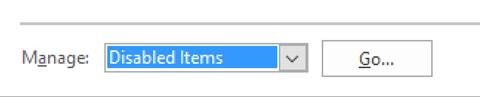
If you see anything with “NetDocuments” listed, select it and click Enable, then click OK.
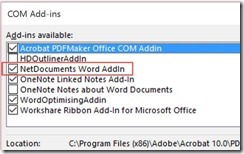
Step 3: Back on the Add-ins screen, change “Manage” to COM Add-ins and click Go
Step 4: Make sure all NetDocuments-related boxes are checked, then click OK
Step 5: Close and reopen the application
If Office Tries to Disable the Add-in Again
When you reopen the application, you may see a message asking about the add-in. If prompted:
- If you see “View Disabled Add-ins,” click it and re-enable
- If asked whether to disable the add-in, click No
Prevent This From Happening Again
If you’re an Optiable customer, we have a batch file that prevents Microsoft Office from automatically disabling the NetDocuments add-ins. If your plugins keep disappearing, the batch file either wasn’t run during setup or needs to be run again.
You can find the batch file and instructions on our “Set Up NetDocuments on a Windows Computer” page.