

Understanding the differences between Copy, Move, and File in NetDocuments is essential for efficient document management. Each operation serves a distinct purpose and has different effects on your documents, version history, and storage. Let’s explore each operation with practical scenarios.
Quick Reference Table
| Operation | New Doc ID? | Version History | Storage Impact | Original Document | Use When |
|---|---|---|---|---|---|
| Copy | Yes | No | Increases | Remains untouched | You need a template or starting point for a new document |
| Move | No | Yes (all versions) | None | Removed from original location | Document is in the wrong location |
| File | No | Yes (all versions) | None | Remains in place | Document needs to appear in multiple locations |
Understanding Document IDs
One of the most important differences between these operations is how they handle Document IDs:
- Copy creates a NEW Document ID for the copied document
- Move keeps the SAME Document ID
- File keeps the SAME Document ID (because it’s the same document appearing in multiple locations)
This is crucial for document tracking, linking, and integration purposes with other systems.
Scenario 1: COPY
Use Case: I have a form I need to reuse. I will copy that form into a different matter, while leaving the original untouched.
When to Use Copy
- Creating a new document from a template
- Using a precedent document as a starting point
- Making a form that needs customization for a new matter
- Any time you need a separate, independent document
What Happens When You Copy
- A new document is created with a new Document ID
- Only the current/official version is copied (version history does NOT transfer)
- The original document remains untouched in its location
- You can modify metadata during the copy process
- Storage increases because you now have two separate documents
Step 1: Check the box next to the Document
Step 2: Click More> Move/Copy
Step 3: Choose the new location
Step 4: Click Copy
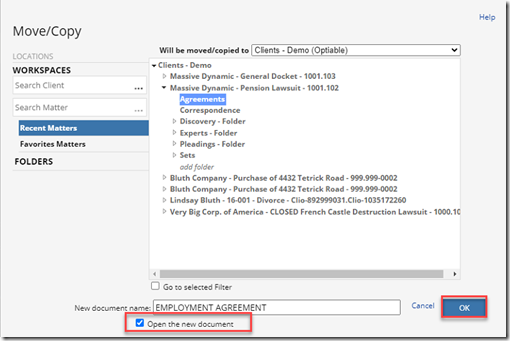
NetDocuments lets you open the Document and change its name before you click Okay.
Scenario 2 MOVE:
Use Case: I created a Folder Called Experts in NetDocuments that lists all my experts.
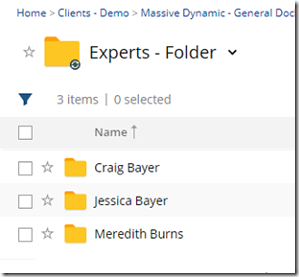
I have all my expert documents in the expert doc type filter:

I want to move the documents into the Experts Folder. None of these documents will need to be in more than one folder.
When to Use Move
- The document was saved to the wrong location
- Reorganizing your workspace
- Document belongs in only ONE location
- Cleaning up folder structure
What Happens When You Move
- The same Document ID is retained
- ALL version history moves with the document
- The original document is removed from its location and placed in the new location only
- Metadata stays with the document
- No additional storage is used
Step 1: Check the box next to the Document
Step 2: Click More -> Move/Copy
Step 3: Choose the new location
Step 4: Click Move
Scenario 3: FILE
Use Case: I have a client with 25 matters. We have a discovery folder on each matter. The client has specific discovery instructions that I want to include in all discovery folders. I want to update those instructions and have them updated in each of the Discovery Folders.
- Document needs to appear in multiple client/matter folders
- Standardized documents (policies, procedures, guidelines)
- Documents that should update across all locations when edited
- Reference materials needed in multiple matters
What Happens When You File
Unlike Move, File lets you put items in multiple folders. In this scenario, we have one set of discovery instructions. We have filed those instructions in 25 separate folders. When I update one document, it updates the document in each location, because there is only one document.
- The same Document ID is retained
- ALL version history is maintained
- The original document remains in its location AND appears in new location(s)
- The same metadata appears in all filing locations (since it’s one document)
- No additional storage is used (it’s a reference/pointer, not a copy)
This is a powerful feature unique to document management systems like NetDocuments. Windows file systems don’t have this capability – they would create duplicate copies.
Steps to File a Document
Step 1: Check the box next to the Document
Step 2: Select More –> Move\Copy
Step 3: Choose the new location
Step 4: Click File.
Note: You previously had advanced filing enabled, as discussed here: https://www.optiable.com/what-is-advanced-filing-in-netdocuments/, but that is the case anymore.
Key Differences Explained
Version History Behavior
Copy:
- Creates a new document with NO version history
- Only the current/official version is copied
- The copied document starts fresh with version 1
Move:
- Keeps ALL version history intact
- Same Document ID means all historical versions remain accessible
- Perfect for maintaining audit trail when reorganizing
File:
- Keeps ALL version history because it’s the same document
- Updates appear in all filed locations simultaneously
- Version changes are reflected everywhere the document is filed
Storage Implications
Copy:
- Increases storage – you now have two independent documents
- Each copy takes up space based on file size
- Multiple copies of the same document can quickly consume storage
Move:
- No storage impact – same document, different location
- Most efficient for reorganization
File:
- No storage impact – it’s a reference, not a duplicate
- One document appears in multiple locations without duplication
- Ideal for documents needed across multiple matters
Metadata and Profile Attributes
Copy:
- You can modify metadata/profile attributes during the copy process
- Useful for updating matter information, document type, etc.
- Each copy can have different metadata
Move:
- Metadata stays with the document unchanged
- Profile attributes remain the same unless manually edited
File:
- Same metadata appears in all filing locations
- Changing metadata in one location changes it everywhere
- Consistent information across all filed locations
Bulk Operations
You can select multiple documents at once and perform Copy, Move, or File operations on all of them simultaneously. This is particularly useful when:
- Moving entire folders between workspaces
- Filing multiple documents to the same locations
- Copying a set of template documents for a new matter
Simply select multiple checkboxes before clicking More → Move\Copy.
Best Practices
Use Copy When:
- You need a template or precedent for a new document
- Creating forms for different matters
- You want an independent document that won’t affect the original
- Version history doesn’t need to transfer
Use Move When:
- A document is in the wrong location
- You’re reorganizing your workspace
- The document should only exist in ONE location
- You want to preserve version history and Document ID
Use File When:
- A document needs to appear in multiple client/matter folders
- You want updates to appear everywhere the document is filed
- Working with standardized documents (policies, guidelines, forms)
- Storage optimization is important (no duplication)
Important Notes
Cabinet Administrator Settings
If you don’t see the File option when trying to file documents in multiple locations, your cabinet may have the “Force filing in a folder” setting enabled. This is a cabinet-level setting that must be configured by a NetDocuments administrator:
To Enable Filing in Multiple Locations:
- Go to Cabinet Administration
- Locate “Force filing in a folder” setting
- Ensure it is UNCHECKED/DISABLED
- Save changes
Once this setting is disabled, users can file documents in multiple folders. NOTE: You only need to do this for folder-based cabinets. A workspace-based cabinet doesn’t need this setting checked.
Single Document, Multiple Locations
When you use the File operation, remember: there is only ONE document. It’s not creating copies – it’s creating references or pointers to the same document. This means:
- Editing in any location edits the same document
- Deleting from one location doesn’t delete from others (just removes that reference)
- Version changes appear everywhere simultaneously
Document ID Tracking
Document IDs are crucial for:
- Integration with practice management systems
- Document linking and cross-referencing
- Audit trails and compliance
- API operations and automation
Understanding when Document IDs change (Copy) versus when they’re preserved (Move/File) is essential for maintaining these integrations.
Further Reading
For more information about NetDocuments file operations, check out these resources:
- NetDocuments Support – Move/Copy/File a Document
- NetDocuments Support – Move/Copy a Folder
- What is Advanced Filing in NetDocuments?
Need Help with NetDocuments?
If you’re looking for expert guidance on NetDocuments implementation, migration, or optimization, Optiable specializes in helping law firms make the most of their document management systems. With over 523 NetDocuments implementations completed, we understand the nuances of these operations and can help your firm establish best practices.
Contact Optiable for a consultation about your NetDocuments needs.