

When attorneys file emails into NetDocuments from Outlook, four tools can do that work: ndSave, ndMail, ndMail Folder Mapping, and the NetDocuments Outlook 365 Integration. They handle email filing differently, and those differences explain most of the “why won’t this file?” questions we hear — and most of the unexpected duplicates that occasionally show up anyway.
Four Tools, Two File Formats
The first thing to understand is how each tool saves emails:
- ndSave saves emails as .msg files
- ndMail, ndMail Folder Mapping, and the NetDocuments Outlook 365 Integration all save emails as .eml files
That distinction is easy to overlook, but it’s central to how deduplication works across the tools.
What NetDocuments Uses to Detect a Duplicate
NetDocuments checks two things when deciding whether an email already exists:
- The unique Message ID embedded in the email
- NetDocuments security context (cabinet and workspace access)
Both conditions must match for the system to consider them duplicates.
When the Check Happens
The timing differs by tool, and it matters:
- ndMail checks before filing. The moment you click an email in Outlook, ndMail queries NetDocuments. If that email is already filed somewhere you have access to, your filing options will be grayed out immediately.
- ndSave checks during filing. After you click File, it searches for a match. If one exists, the save is quietly blocked.
How the Tools Handle Each Other’s Files
Because ndSave uses a different format than the other three tools, cross-tool deduplication is explicitly built in:
- File via ndSave first, then try ndMail → ndMail sees the .msg and grays out filing options.
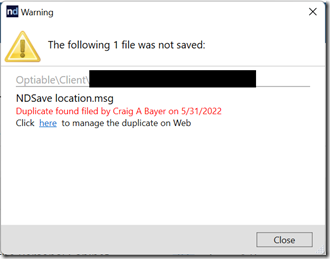
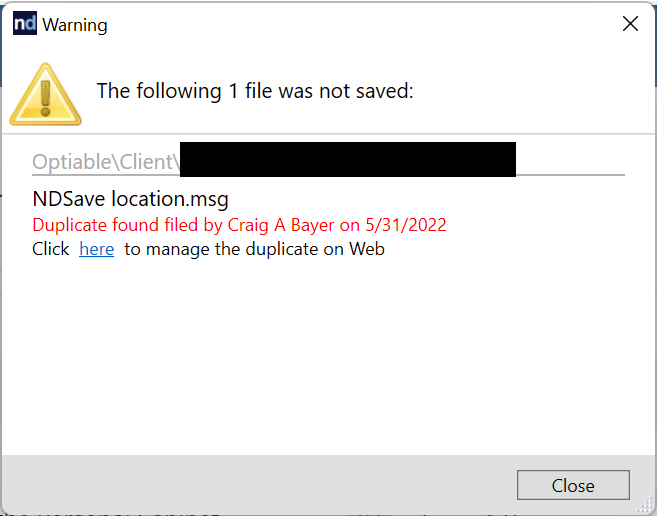
- File via ndMail first, then try ndSave → ndSave shows a warning and blocks the save.
- File twice via ndMail → filing options are grayed out on the second attempt.
- File twice via ndSave → the process appears to run, but the duplicate is not created silently.

How Duplicates Still Happen
Despite the built-in logic, duplicates do occur in three situations:
1. Drag-and-drop uploads. The dedup logic applies only when filing via ndMail or ndSave. If someone files an email through one of those tools and then manually drags the same email into the NetDocuments web browser, the system has no mechanism to catch it — a duplicate will be created.

2. Filing both tools within the same second. If you file via ndSave and immediately file the same email via ndMail, ndMail may run its dedup check before ndSave’s upload has registered in NetDocuments. The check passes because the file isn’t visible yet, and a duplicate is created. This is a timing edge case, but it happens.
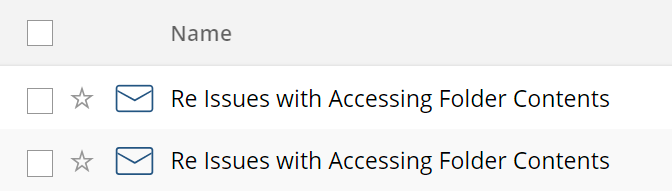
3. Dragging a file email into a folder mapped to NetDocuments. If you send an email from Outlook and save it to NetDocuments using ndSave or ndMail, then take that same sent email and drag it into a folder mapped to NetDocuments, a duplicate will be created. The folder mapping tool has no way to know whether the email has already been filed.
4. The ndMail DeDupeEML Registry Key is not added to NetDocuments. In that case, you can save an email via ndSave, and then via ndMail and it will duplicate.
Extending Dedup to .eml Files with the DeDupeEML Registry Key
NetDocuments added an opt-in registry setting that extends deduplication logic to .eml files. It has to be set on each workstation where ndMail is installed.
Registry details:
- Key name:
DeDupeEML - Location:
HKEY_CURRENT_USER\SOFTWARE\NetVoyage\NetDocumentsorHKEY_LOCAL_MACHINE\SOFTWARE\NetVoyage\NetDocuments - Type: REG_SZ
- Value:
True
If the key exists in both HKCU and HKLM, the HKLM value takes priority.
What it does:
With DeDupeEML set to True, the dedup check looks for both .eml and .msg versions of the same email. The cross-format logic works like this:
- Filing an .eml when a .msg of the same email already exists → the .eml will not be saved.
- Filing a .msg when an .eml already exists → the .msg will be saved. This is intentional: .msg files can carry attachments that aren’t present in the .eml version.If you are still having issues with email duplication and NetDocuments, I would reach out to NetDocuments tech support: 801.226.6882