

NetDocuments gives you two distinct ways to save email into your document management system: ndOffice and ndMail. They overlap enough to cause confusion, but they’re built for different purposes—and, importantly, installing one changes how the other behaves. If you’ve ever wondered why a colleague’s Outlook looks different from yours, or why a feature you relied on suddenly disappeared, this is almost always the reason.
Here’s how the two compare, what happens when you run them together, and how to restore any features you’re missing.
ndSave
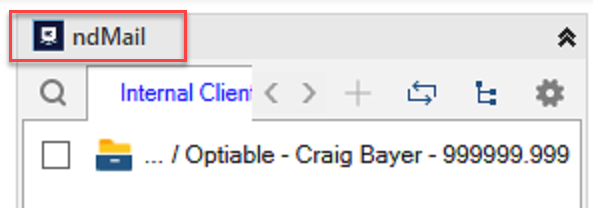
ndMail
ndOffice vs. ndMail: What’s the Difference?
NetDocuments gives you two ways to save email into your document management system: ndOffice (using its ndSave button) and ndMail. They work side by side, but they approach the same task—getting email filed to the right matter—in different ways. Here’s how each one works and when you’d reach for it.
ndOffice and ndSave
ndOffice is the core NetDocuments integration for Outlook. Its ndSave button lets you save an email into NetDocuments manually: you pick the destination matter yourself and file the message where you want it. It’s direct, hands-on, and gives you full control over exactly where every email lands.
This is the workflow to lean on when you want to make the filing decision yourself—for one-off messages, unusual matters, or anytime you’d rather not rely on a prediction.
ndMail
ndMail layers machine learning on top of your email workflow. Instead of you telling it where every email belongs, ndMail predicts the correct matter based on your saving history and the people on the message, then suggests it as you work. It also keeps a column in your Outlook message list showing which matter each email was saved to, so you can see at a glance what’s been filed and where.
The more you use it, the sharper its predictions get. That’s the whole point—for a high volume of email going to a predictable set of matters, ndMail’s predictive filing saves clicks and cuts down on misfiled messages.
Which One Should You Use?
You don’t have to choose one over the other—they’re designed to work together. ndMail handles the day-to-day filing automatically and learns your patterns, while ndSave is always there when you want to take manual control of where a message goes.
For most firms, the practical answer is to let ndMail do the heavy lifting on routine email and use ndSave for anything that needs a deliberate, hands-on decision.
The Short Version
ndOffice is the core NetDocuments integration that lets you save emails (and documents) into NetDocuments manually, choosing the destination matter yourself.
ndMail layers machine learning on top of your email workflow. Instead of you telling it where every email belongs, ndMail predicts the correct matter based on your saving history and the people on the message. Over time, its predictions get sharper, which is the whole point of the tool.
The catch: because ndMail does the same jobs as several ndOffice features—only smarter—NetDocuments automatically disables those overlapping ndOffice features once ndMail is running. Nothing is broken. NetDocuments is simply removing redundant buttons so you’re not doing manually what ndMail now does for you.