

Law firms that migrate from Worldox to NetDocuments often have a hard requirement: an Author field. It’s a familiar metadata point, and attorneys are used to seeing it. NetDocuments can absolutely accommodate this — you can create a custom Author attribute and even configure it to auto-populate based on the logged-in user. There is, however, one important exception to that auto-fill behavior.
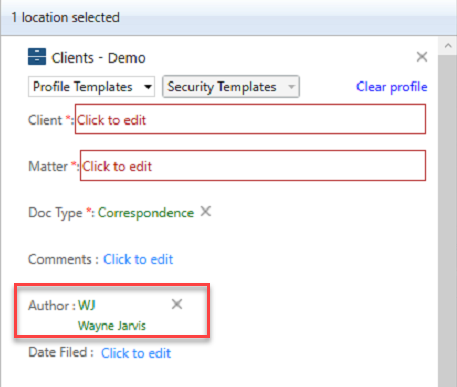
ndMail does not trigger the default Author profile.
When a user saves an email into NetDocuments using ndMail, the system bypasses the default Author logic entirely. The result: the Author field is left blank. When anyone opens that document in NetDocuments later, the Author column is empty — which tends to frustrate firms that specifically asked for that field to be populated.

Why This Happens
The default Author fill is driven by the user’s profile template in NetDocuments and kicks in when a document is saved via the standard desktop or web interface. ndMail operates through a different save path — it handles an email object, not a traditional document — and that path doesn’t use the same profile defaults.
This isn’t a bug so much as a gap between two different save mechanisms. NetDocuments is aware of it, but there’s no native setting to automatically bridge them.
A Note on the Author Field Generally
Frankly, the Author field is a holdover from older DMS platforms like Worldox, where it served a real purpose because the system didn’t readily surface creator and modifier information. NetDocuments handles that differently. When an email is saved via ndMail, the document record already captures:
- Who saved the email in NetDocuments
- Who the email was sent to
- Who the email was sent from
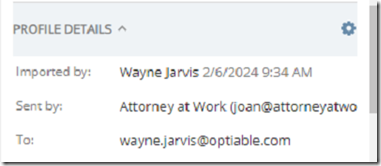
All of those fields are searchable. For most purposes, they tell you everything the Author field was ever meant to convey — and they do it with more precision. That said, if your firm has committed to the Author field and users expect it to be populated, a blank field creates confusion regardless of whether it’s technically redundant.
I am not a big fan of the author field. To begin with, it’s mostly a holdover from legacy DMS systems that didn’t easily show who created or modified the document.
The Fix: Set a Default Author at the Cabinet Level
The cleanest workaround is to configure a static default Author for all emails at the cabinet level in NetDocuments.
In Cabinet Settings, you can set a default for all email documents to a specific Doc Type and Author value. A common approach is to set the Author to something like “Saved from Outlook” — a value that’s clearly descriptive, doesn’t imply a specific person saved it, and keeps the field from being blank.
To make this work, you’ll need to:
- Create an Author value called “Saved from Outlook” (or whatever label your firm prefers) in your attribute list.
- In Cabinet Settings, navigate to the default profile for email documents.
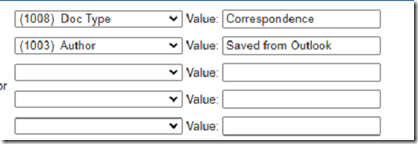
- Set the Author default to that value.

Once this is in place, every email saved through ndMail will automatically carry that Author value. It won’t reflect who saved it — that information is still captured elsewhere — but it eliminates the blank field and the questions that come with it.